Reno St / 34th Street is too dangerous for pedestrians. Every day there are near-misses. Far too frequently, there are collisions between cars and pedestrians.
Here is a map of the recent crashes on this stretch of road:
https://opendata.dc.gov/datasets/DCGIS::crashes-in-dc/explore?location=38.937657%2C-77.065002%2C17
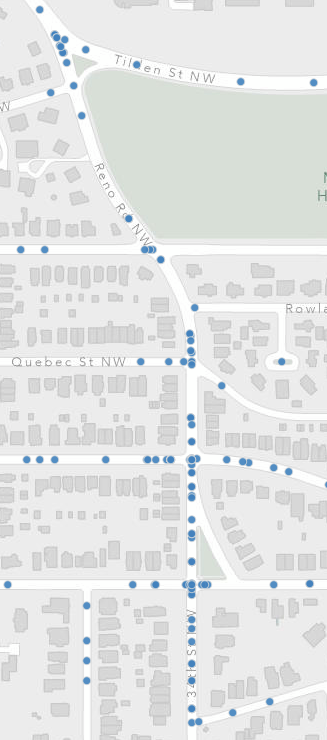
Rodman Street has an intersection with both horizontal curves (20° deflection with a 487-ft-radius curve) and vertical grades (a 6.2% grade over 300 feet) across Reno Road / 34th Street.
Ordway Street has a significant vertical crest (a 9% grade over 300 feet) across Reno Road / 34th Street.
Porter Street has an intersection with steep downgrades for Reno Road / 34th Street (a 10% grade over 300 feet), causing vehicles to accelerate downhill, reducing braking distance.
These factors create sight-distance restrictions and speed issues, making it difficult for drivers to see pedestrians and stop in time.
The MUTCD (Manual on Uniform Traffic Control Devices) Standards require adequate pedestrian safety infrastructure to be installed where crosswalks cross roads with horizontal grades and/or or vertical curves. The HAWK signal on Rodman does not meet MUTCD guidelines – where visibility is obscured, HAWK signals should show RED lights, not yellow (§4J.02 ¶5, page 729). Yellow flashing HAWK beacons are inadequate if it is documented that drivers don’t stop at them – yellow lights serve as a suggestion to stop, not a requirement to stop (§4J.02 ¶5, page 94).
The Federal Highway Transportation Administration (FHWA) and American Association of State Highway and Transportation Officials (AASHTO) guidelines say that where sight-distance deficiencies are caused by a fixed crest and/or curve, traffic control measures like stop lights and stop signs are the standard engineering response (Page 39).
The ADA Accessibility Guidelines (ADAAG) and The Public Right-of-Way Accessibility Guidelines (PROWAG) state that intersections with factors that block sightlines should include stop signs or stop lights to allow safe pedestrian crossing for individuals with mobility impairments like children and the elderly, and that such crossings are only ADA compliant if they include raised crossings (§R302.5.2.2, §R302.5.2.3, §R302.5.2.1).
As documented on this site, near-misses between pedestrians and cars are an everyday occurrence on this stretch of Reno Road / 34th Street, and actual collisions occur far too frequently.
What we are asking for:
We are families whose children cross this road every day. We ask DDOT to:
- Conduct a Traffic Safety Assessment of Reno Road and the intersections with Rodman Street, Ordway Street, and Newark Street under MUTCD §2B.14 and §2B.17, page 79, including a field sight-distance survey.
- Install raised crosswalks at Rodman Street, Rowland Place, Ordway Street, and Newark Street — a FHWA Proven Safety Countermeasure associated with a 45% reduction in pedestrian crashes.
- Install all-way stops at Reno Road where it crosses Rodman Street, Ordway Street, and Newark Street, and remove the inadequate HAWK beacon on Rodman.
Leave a Reply